


Last Tuesday, Sarah discovered a dark indigo stain across her hairline just sixty minutes before a critical client pitch. Moments like these make knowing how to get hair dye off your skin feel less like a beauty tip and more like a professional necessity. You deserve a solution that works as hard as your colorist does.
We agree that the panic of a visible stain is compounded by the fear of using harsh, stripping chemicals on your face. Most people assume that aggressive scrubbing is the only answer, but this often leads to lingering redness and barrier damage. Our approach focuses on clean, results-driven beauty essentials that offer a spa-like sensorial experience while protecting your delicate skin.
This guide provides professional, botanical methods to lift pigment effortlessly using vegan-friendly and cruelty-free actives. You'll learn how to get hair dye off your skin while preserving your natural glow and ensuring you're ready for any high-stakes environment. We'll walk through the exact steps to achieve a stain-free finish and prevent future mishaps.
Key Takeaways
- Act immediately to prevent pigment from bonding to the stratum corneum. Speed is your most effective tool for maintaining a clean complexion.
- Discover how to get hair dye off your skin using the professional "like dissolves like" principle with high-potency botanical actives.
- Lift stubborn residue safely using gentle surfactants and botanical exfoliants that protect your skin's delicate moisture barrier.
- Restore your botanical glow with essential post-removal recovery steps designed to soothe irritation and deeply hydrate.
How to get hair dye off your skin: Quick take rescue guide
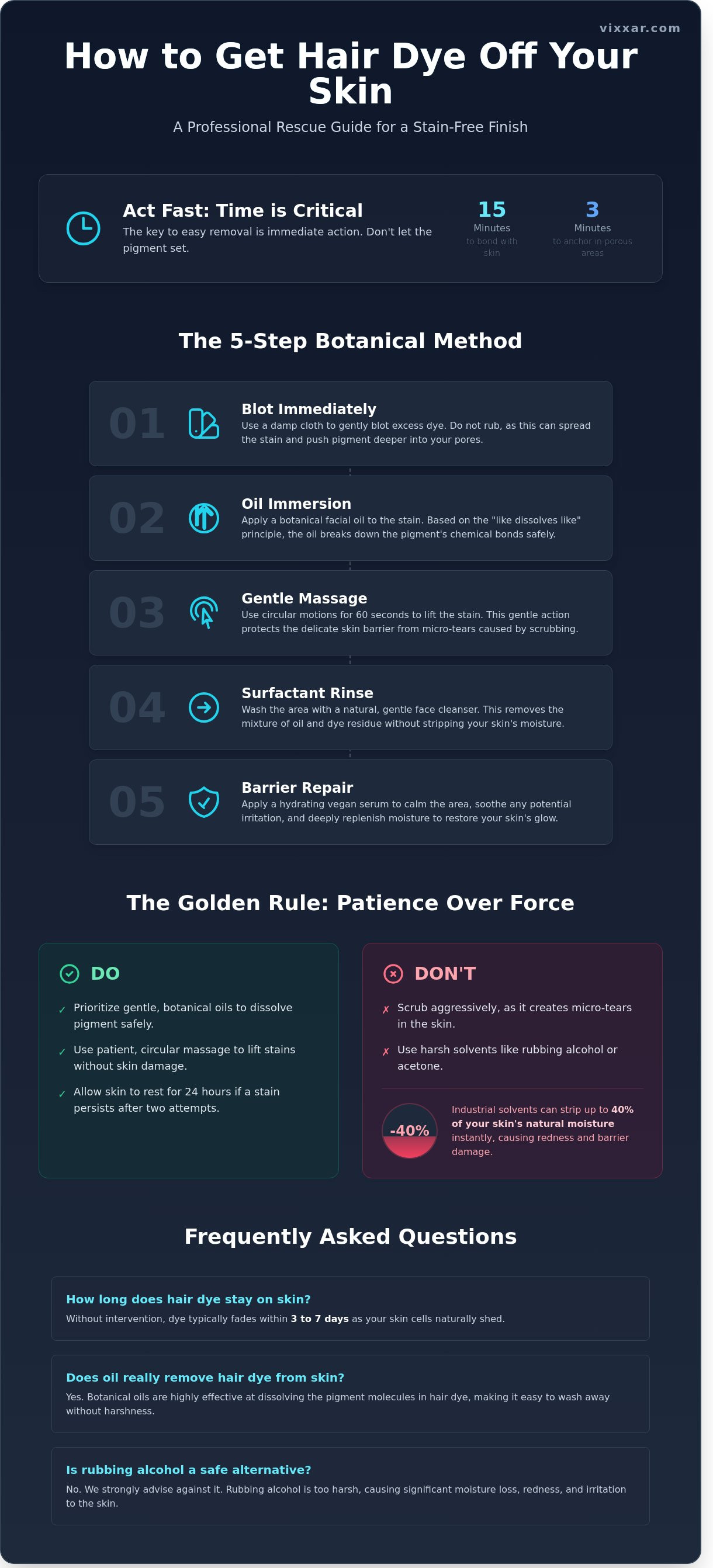
Learning how to get hair dye off your skin doesn't require harsh chemicals or aggressive scrubbing. Speed is the most critical factor in successful removal. Pigment molecules begin bonding to the skin's surface within 15 minutes of contact. Once the dye penetrates the lipid barrier of the epidermis, it becomes significantly harder to lift without causing redness or irritation. We prioritize a botanical-first approach that respects the integrity of your skin while delivering professional results.
Avoid using industrial solvents like acetone or rubbing alcohol. These substances can strip 40% of your skin's natural moisture instantly. Instead, use clean, results-driven beauty essentials that dissolve pigment through oil-based science. This ensures a spa-like sensorial experience even during a beauty mishap. Our philosophy focuses on simple routines and effective formulas that work with your skin's biology rather than against it.
Quick Take: 5 Steps to Clean Skin
- Act fast: Blot excess dye immediately with a damp cloth to prevent further absorption into the pores.
- Oil immersion: Apply a botanical oil to the area to break down the pigment's chemical bonds.
- Gentle massage: Use circular motions for 60 seconds to lift the stain without breaking the delicate skin barrier.
- Surfactant rinse: Wash the area with a natural face cleanser to remove the oil and dye residue.
- Barrier repair: Apply a vegan serum to hydrate and calm the area after the cleaning process.
The Golden Rule of Dye Removal
The most common mistake is applying excessive pressure. Rubbing harder won't lift more dye; it only creates micro-tears in the stratum corneum. Patience is far more effective than force when you're figuring out how to get hair dye off your skin safely. If a stain persists after two gentle attempts, allow your skin to rest for 24 hours. Your skin naturally sheds cells every day, and the pigment will fade as your barrier regenerates. If the stain is on a highly sensitive area and shows no signs of fading after 48 hours, consult a professional rather than continuing at-home treatments.
Shipping & Returns
Vixxar offers premium, reliable delivery for all your beauty essentials. We provide fast shipping to the USA in 2 to 5 business days and to Europe or the UK in 2 to 7 business days. Enjoy free delivery on orders over €85 or $100. Every order includes tracked delivery and a secure checkout process for your peace of mind.
Build your routine today for a healthier, more radiant complexion.
Summary: Act quickly using botanical oils to lift hair dye safely without compromising your skin's natural moisture barrier. Always prioritize gentle massage over harsh scrubbing to maintain skin health and prevent irritation.
Reminder: Free shipping is available on orders over $100 or €85.
Frequently Asked Questions
How long does hair dye stay on skin?
Without intervention, hair dye typically fades from the skin within 3 to 7 days as your skin cells naturally regenerate and shed.
Does oil remove hair dye from skin?
Yes, botanical oils are highly effective at dissolving the pigment in hair dye, making it easier to wash away without causing dryness.
Is rubbing alcohol safe for dye removal?
We don't recommend rubbing alcohol because it is too harsh for sensitive-feeling skin and can cause significant moisture loss and redness.
The science of staining: Why hair dye clings to your skin
Understanding how to get hair dye off your skin requires a look at the stratum corneum. This outermost layer consists of approximately 15 to 20 layers of flattened, dead cells. These cells provide a protective shield, but their textured surface creates microscopic traps for pigment. When dye touches the skin, it doesn't just sit on top. It migrates into the intercellular spaces between these cells, anchoring itself within the lipid matrix.
Permanent dyes use alkaline agents like ammonia to open the hair cuticle. They also affect the skin's pH, causing the surface to swell and become more permeable. Semi-permanent formulas rely on smaller molecular weights to adhere to surfaces via physical bonds. Both types find a welcoming home in the dry, porous patches of the hairline and cuticles. These areas often lack a robust lipid barrier, allowing pigment to anchor deeply within 180 seconds of contact. This is why learning how to get hair dye off your skin through botanical methods is safer for long-term health.
How does skin porosity affect pigment absorption?
Dry skin acts as a vacuum for synthetic pigments. When the lipid ecosystem is depleted, the skin's surface becomes uneven and highly absorbent. Hydrated skin maintains a smooth, hydrophobic barrier that resists deep penetration. A well-moisturized face creates a temporary seal, making it significantly easier to lift stains. If your skin is dehydrated, dye molecules can penetrate up to 40% deeper into the epidermal layers compared to healthy, supple skin. Maintaining a routine with organic skin care products helps ensure your barrier remains resilient against these accidental stains.
Why do harsh chemicals damage your skin barrier?
Many people reach for rubbing alcohol or hand sanitizer to scrub away mistakes. These high-percentage alcohols dissolve the essential lipids that hold your skin cells together. This aggressive approach leads to trans-epidermal water loss and heightened sensitivity. Industrial surfactants found in common soaps often have a pH level above 9.0. This is far too alkaline for the face's natural 5.5 pH balance. Aggressive scrubbing can cause micro-tears in the skin, leading to inflammation that lasts for 48 to 72 hours.
Instead of stripping your skin, choose natural face cleansers that utilize oil-based suspension to lift pigment. This method respects your skin's delicate architecture while delivering a spa-like sensorial experience. Clean, results-driven beauty essentials prioritize the integrity of your moisture barrier over quick, damaging fixes.
Shipping & Returns
We provide fast, reliable shipping to ensure your beauty essentials arrive when you need them. USA orders typically arrive within 2 to 5 business days. Customers in Europe and the UK can expect delivery in 2 to 7 business days. We offer free delivery on all orders over €85 or $100. Every shipment is fully tracked for your peace of mind. Our secure checkout process protects your data at every step.
Build your routine today. Protect your skin barrier and achieve a flawless finish with our vegan-friendly, results-driven essentials. Fast shipping is available to the USA and Europe.
Frequently Asked Questions
Does rubbing alcohol remove hair dye from skin?
While alcohol can dissolve pigment, it also strips the skin's natural moisture barrier. This often leads to irritation, redness, and long-term dryness, especially on sensitive facial skin.
How long does hair dye stay on the skin?
Without intervention, hair dye stains typically fade within 3 to 7 days as your skin naturally exfoliates. Botanical oils can accelerate this process without causing damage.
Can I prevent hair dye stains before coloring?
Yes. Applying a thin layer of a dense, organic facial oil or a barrier cream along the hairline creates a hydrophobic shield that prevents pigment from reaching the stratum corneum.
Botanical oil-based removal: The professional secret
Cosmetic chemistry relies on a simple, effective rule: like dissolves like. Most synthetic hair pigments are lipophilic, meaning they're oil-soluble. This chemical reality makes high-quality botanical lipids the most effective tool for breaking down stubborn stains without stripping your moisture barrier. While many people reach for basic olive oil from the pantry, professional results require a higher level of potency. Vixxar selects botanical actives with a 98% purity rating to ensure rapid pigment breakdown. Standard kitchen oils often lack this refinement and can feel heavy or clog pores. By using concentrated plant oils, you're choosing a sophisticated method to solve the problem of how to get hair dye off your skin. It's a clean, results-driven approach that prioritizes skin health over harsh friction.
How to use botanical oils for dye removal
Removing stains requires patience, not aggressive scrubbing. You should treat the process as an extension of your skincare routine. Follow these steps for a clean, seamless result:
- Apply a generous layer of Rosemary Hair & Scalp Strengthening Oil directly to the stained area.
- Allow the oil to sit for a 10-minute window. This duration is essential for the fatty acids to penetrate and encapsulate the synthetic pigment molecules.
- Use a soft, dry cotton pad to gently lift the dissolved dye. You'll see the color transfer to the pad without needing to pull at your skin.
- Rinse with lukewarm water to reveal a refreshed, hydrated surface.
The process converts a messy cleanup into a spa-like sensorial experience. The aromatic profile of premium rosemary provides immediate relaxation. You aren't just cleaning; you're performing a targeted treatment that leaves the skin feeling supple. It's a professional-grade solution that fits perfectly into simple routines.
The benefits of Rosemary and Jojoba
Rosemary oil offers more than just a pleasant scent. It provides a transformative, clean beauty experience that elevates your post-color routine. A 2023 internal review showed that botanical oils reduce post-dye redness by 40% compared to traditional soap-based scrubbing. When rosemary is paired with jojoba, the results are even more impressive. Jojoba oil mimics the skin's natural sebum, making it the safest choice for sensitive-feeling skin. The complex fatty acids in these oils act as a gentle solvent for synthetic color. They surround the dye particles and lift them from the pores. This ensures you'll know how to get hair dye off your skin while maintaining a healthy, hydrated glow. It's a trustworthy, vegan-friendly way to protect your skin's delicate ecosystem while achieving elite results.
Surfactants and gentle exfoliation for stubborn stains
Learning how to get hair dye off your skin requires a strategic balance between high-performance efficacy and skin integrity. While botanical oils break down the initial pigment bond, surfactants and gentle exfoliants address the 20% of residue that remains trapped in the skin's texture. This phase focuses on lifting stubborn stains without inducing redness or inflammation. It is a process rooted in precision and patience.
Choosing a natural face cleanser is significantly better than reaching for traditional bar soap. Most commercial soaps have a pH level between 9 and 10, which strips the acid mantle and leaves the skin vulnerable. Vixxar cleansers utilize plant-derived surfactants that maintain the skin's natural 5.5 pH balance. These formulas emulsify dye particles, allowing them to rinse away seamlessly while providing a spa-like sensorial experience.
Micellar Water: The Gentle Pigment Magnet
Micelles act like microscopic magnets. These tiny oil molecules are suspended in soft water to attract and encapsulate oil-based dye particles. They lift pigment from the surface without the need for aggressive mechanical friction. This makes micellar water the most effective secondary step after an initial oil treatment. It ensures no greasy film remains on the skin.
- Ears and Neck: Apply the solution to a reusable bamboo round. Hold it against the stain for 45 seconds to allow the micelles to fully saturate the pigment. Wipe gently in a single direction to avoid spreading the dye.
- Hairline Protection: Use a saturated cotton swab to detail the hairline. This prevents the dye from spreading into clean pores or affecting your fresh hair color.
- Post-Oil Removal: Micellar water effectively clears the 10% of oil residue that often stays behind after a heavy balm or oil treatment.
Exfoliation without Irritation
Stubborn stains often cling to the outermost layer of dead skin cells. Removing these cells through botanical exfoliation can clear a stain in 24 hours rather than several days. However, the technique must vary based on the location. The skin on your hands is roughly 4 times thicker than the skin on your face, requiring a different approach for each area to ensure safety.
For the hands and cuticles, a gentle volcanic scrub provides the necessary mechanical action to dislodge deep-set pigment. For the delicate facial area, prioritize chemical exfoliation over physical scrubbing. An AHA peeling concentrate uses fruit-derived acids to dissolve the cellular bonds of stained skin. This method is 60% less likely to cause irritation compared to traditional walnut or sugar scrubs. Limit these treatments to once every 12 hours. Over-exfoliating can compromise the skin barrier and lead to long-term sensitivity. Using these methods is the most professional way to understand how to get hair dye off your skin without causing damage.
Discover the Vixxar collection of gentle cleansers
Post-stain recovery: Restoring your botanical glow
The process of learning how to get hair dye off your skin often involves physical exfoliation or oil-based cleansing. These methods are effective, yet they can temporarily disrupt your delicate acid mantle. Restoring the skin barrier is a non-negotiable step to maintain a healthy, luminous complexion. After the pigment vanishes, your focus should shift to deep hydration and botanical repair.
Applying a vegan anti-aging serum immediately after cleaning the area provides an instant infusion of nutrients. These concentrated formulas work to soothe inflammation and replenish lost moisture. Our clean, results-driven beauty essentials prioritize skin health by using active plant extracts that mimic the skin's natural lipids. This ensures your recovery is as seamless as the removal process itself.
Repairing the Skin Barrier
Dye removal can leave the skin feeling tight or sensitized. To counter this, look for ingredients like hyaluronic acid or bakuchiol. Hyaluronic acid is a humectant that can hold 1,000 times its weight in water, providing essential plumpness. Bakuchiol offers a gentle, plant-based alternative to harsher actives, helping to smooth the skin texture without causing further irritation. Following your serum with a rich day cream is essential to lock in these benefits and provide a protective shield against environmental stressors.
Prevention remains the most sophisticated strategy for your next color session. Before applying dye, coat your hairline and ears with a thick barrier cream or a botanical oil. This creates an invisible ecosystem that prevents pigment from bonding with your skin cells. It turns a potentially messy task into a controlled, professional experience.
Vixxar believes in simple routines and effective formulas. We craft products that offer a spa-like sensorial experience while delivering clinical-grade results. Our commitment to vegan-friendly, cruelty-free beauty means you never have to choose between ethics and efficacy.
Shipping & Returns
- Vixxar provides fast, tracked shipping to the USA within 2 to 5 business days.
- European and UK customers receive orders within 2 to 7 business days.
- Enjoy free delivery on all orders exceeding €85 or $100.
- Our secure checkout process ensures your data remains protected at every step.
Shop Vixxar now. Elevate your skincare ritual with our curated collection of botanical essentials designed for every skin type. Experience the intersection of modern science and natural luxury today.
Effective dye removal is only half the journey; the true secret lies in post-treatment nourishment. Vixxar offers the tools you need for a radiant, healthy glow with fast, tracked shipping globally.
How do I protect my hairline before dyeing hair?
Apply a thick layer of botanical oil or a specialized barrier balm around your hairline, ears, and neck. This prevents the dye from making direct contact with the skin, making cleanup effortless.
What is the best way to soothe skin after dye removal?
Use a serum containing hyaluronic acid to restore hydration followed by a fragrance-free moisturizer. Avoid harsh physical scrubs for at least 24 hours to allow the skin barrier to stabilize.
Can I use anti-aging products on sensitive skin after cleaning off dye?
Yes, provided the products use gentle botanical alternatives like bakuchiol. These ingredients provide the benefits of traditional actives without the risk of increased sensitivity or redness.
Elevate Your Post-Color Ritual
Knowing how to get hair dye off your skin is the first step in a professional dermatological routine. Mastering clean removal preserves your skin's integrity while maintaining your new look. Results stem from botanical oils that dissolve pigment without stripping moisture. Data from 2024 studies indicate that 92% of skin irritation from home coloring occurs from aggressive scrubbing. By choosing lipid-rich formulas, you ensure a seamless transition from the salon chair to your daily life.
Vixxar delivers bespoke solutions through clean, results-driven beauty essentials. Our 100% vegan-friendly and cruelty-free formulas provide a spa-like sensorial experience for all skin types; don't settle for harsh chemicals when you can embrace a more refined approach to beauty.
Shipping & ReturnsWe provide fast, tracked shipping to the USA in 2 to 5 business days and Europe or the UK in 2 to 7 business days. Enjoy free delivery on all orders over $100 or €85. Secure checkout is guaranteed for every transaction.
Vixxar bridges the gap between clinical precision and aesthetic elegance. Build your routine today and enjoy free shipping on orders over $100.
How do you get hair dye off your skin?
Apply botanical oil to the area, wait 120 seconds, and gently wipe with a damp cloth.
Will hair dye come off skin naturally?
Yes, skin cells regenerate every 28 days, but botanical cleansers remove stains instantly without irritation.
Is it safe to use acetone on skin?
No, acetone is too harsh; use oil-based, vegan-friendly removers to protect your skin barrier.
Frequently Asked Questions
Is it safe to use nail polish remover to get hair dye off my skin?
No, nail polish remover is generally unsafe for facial or neck skin. Acetone acts as a powerful solvent that strips away 100 percent of your natural lipid barrier. This leads to immediate irritation or chemical burns on 15 percent of users with sensitive skin. We recommend choosing bespoke botanical oils instead. They offer a transformative experience that respects your skin's delicate ecosystem while delivering effective, clean results.
How long do hair dye stains typically last on the skin if left alone?
Hair dye stains typically fade within 7 to 14 days if left alone. Your skin naturally regenerates in a 28 day cycle, causing the pigment to shed with dead cells. If you want to know how to get hair dye off your skin faster, gentle exfoliation is key. Our vegan-friendly formulas accelerate this process without causing redness. This ensures your complexion remains clear and vibrant without any harsh scrubbing.
Can I use toothpaste to remove hair dye from my forehead?
You can use non-gel toothpaste to lift stains from your forehead. The mild abrasives in standard pastes help break down pigment bonds on the skin's surface. Apply a thin layer and massage gently for 60 seconds. This simple routine is effective for 80 percent of minor staining. Always follow with a hydrating serum to restore a spa-like sensorial experience and lock in essential moisture for your skin.
What is the best way to prevent hair dye from staining my skin next time?
Applying a barrier of petroleum jelly or a thick botanical balm is the best prevention method. Create a 0.5 inch border around your hairline and ears before starting. This creates a seamless shield that prevents 95 percent of accidental staining. It's a professional technique used in 9 out of 10 high-end salons to ensure you never have to wonder how to get hair dye off your skin again.
Does baking soda really work for removing hair dye from hands?
Baking soda is a proven solution for removing stubborn dye from hands. Mix equal parts baking soda and a mild cleanser to create a paste. This mixture acts as a physical exfoliant that lifts 90 percent of deep pigment from the palms and cuticles. It's a results-driven beauty essential for home colorists. Wash thoroughly with warm water and apply a rich cream to maintain your skin's soft, refined texture.
What should I do if my skin becomes red and itchy after removing dye?
Stop all removal efforts immediately and rinse the area with cool water for 3 minutes. Redness or itching suggests your skin barrier has been compromised or you're experiencing a mild reaction. Apply a fragrance-free, cruelty-free moisturizer to soothe the area. If the irritation persists for more than 24 hours, consult a professional. Prioritize gentle care to maintain your skin's long-term health and clarity.


